

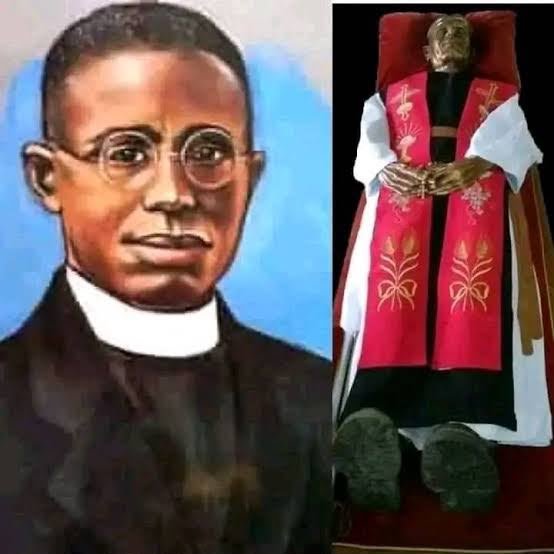
On March 22, 1998, Nigeria received something it had never had before: a Blessed of its own.
In Onitsha, before a vast gathering of Catholic faithful, Pope John Paul II beatified Father Cyprian Michael Iwene Tansi, the Nigerian priest whose life had been marked by prayer, service, sacrifice and an extraordinary devotion to the people he served.
Nearly three decades later, Nigeria is still waiting for the next step.
Father Tansi remains Blessed.
And the question that refuses to grow old is simple: when will Nigeria finally have its first saint?
Born in 1903 in Aguleri, present-day Anambra State, Father Tansi was ordained a priest in 1937.
He spent years serving his people, promoting education and helping to establish a Christian community at a time when Catholicism was still taking deep root in southeastern Nigeria.
His influence reached further than he could have known. Among those touched by his ministry was a young Francis Arinze, whom Father Tansi baptised and who received his early education in one of the schools connected with his work.
Arinze would later become a cardinal of the Catholic Church.
Father Tansi eventually travelled to England and entered Mount St Bernard Abbey, a Trappist monastery, embracing a life of prayer and contemplation.
He died there in 1964, far from the Nigerian communities where his ministry had flourished.
But death did not end his story.
Decades later, his name returned to the land where his life’s work had taken root. During the 1998 beatification ceremony, Pope John Paul II described Father Tansi’s life as an inspiration to the Nigeria he had loved so much.
The Pope also said: “Today, one of Nigeria’s own sons, Father Cyprian Michael Iwene Tansi, has been proclaimed ‘Blessed’ in the very land where he preached the Good News of salvation and sought to reconcile his fellow countrymen with God and with one another.”
The words captured something important about Father Tansi’s legacy. He was not being honoured merely as a priest from Nigeria’s past.
His life was being presented as an example of what faith, service and reconciliation could mean in the life of a nation.
But beatification is not canonization.
A person declared Blessed may be publicly venerated in a particular place or community, while canonization is the formal declaration by the Pope that the person is a saint for the universal Church.
The journey between the two can involve extensive investigation into the candidate’s life and the recognition of miracles attributed to the person’s intercession.
According to the latest available reports on Father Tansi’s cause, another miracle attributed to his intercession must be officially recognised before his canonization can proceed.
That is where the long wait becomes particularly striking.
Nearly 30 years have passed since his beatification. Children who witnessed that historic ceremony have grown old.
Some of the people who gathered in Onitsha that day are no longer alive. Yet Father Tansi remains where the Church placed him in 1998: Blessed.
For some Nigerian Catholics, however, his spiritual influence has never diminished.
Speaking to Owerri Chronicles, Joseph Akande, a Catholic faithful from Abuja who travelled to Onitsha on pilgrimage, said he was enthralled by the magnificence of Father Tansi’s grave and the atmosphere surrounding the shrine.
He also said he had received an answer to a petition he made through Father Tansi’s intercession, although not all his prayers were answered.
Lilian Ndukwu, a Catholic faithful from Owerri and a former member of the Father Tansi Association, also told Owerri Chronicles that she believes his intercession remains potent.
Their experiences are personal testimonies of faith, not officially recognised miracles. But they offer a glimpse into why Father Tansi’s memory remains alive among the faithful while Nigeria waits for the Church’s next decision on his cause.
And perhaps that is what makes the story of Father Tansi so compelling. The Church may still be discerning his journey towards sainthood, but among many who admire his life and seek his intercession, his relevance has never been confined to a page in history.
The question, however, is not only when Father Tansi will become a saint. It is also what Nigerians have done with the example he left behind.
At his beatification, Pope John Paul II told Nigerian Catholics: “The Catholics of Nigeria must be authentic and effective witnesses to the faith in every aspect of life, both in public affairs and in private matters.”
Nearly three decades later, those words still place a responsibility on the people who celebrate Father Tansi’s name.
A country does not truly honour a holy man merely by preserving his memory or waiting for a title.
It honours him when the values he lived for continue to find expression in the lives of those who come after him.
Father Tansi has been waiting nearly 30 years for the Church’s final word.
Nigeria has been waiting with him.
Perhaps one day, the bells will ring again and Nigerians will gather to celebrate the moment when Blessed Cyprian Michael Iwene Tansi finally becomes Saint Tansi.
Until then, his story remains unfinished.
But the years have already proved one thing: a life lived in service may outlast the person who lived it, and sometimes the longest wait is not for a name to be placed on a calendar, but for a nation to understand the meaning of the life it has been given to remember.







Leave a comment