

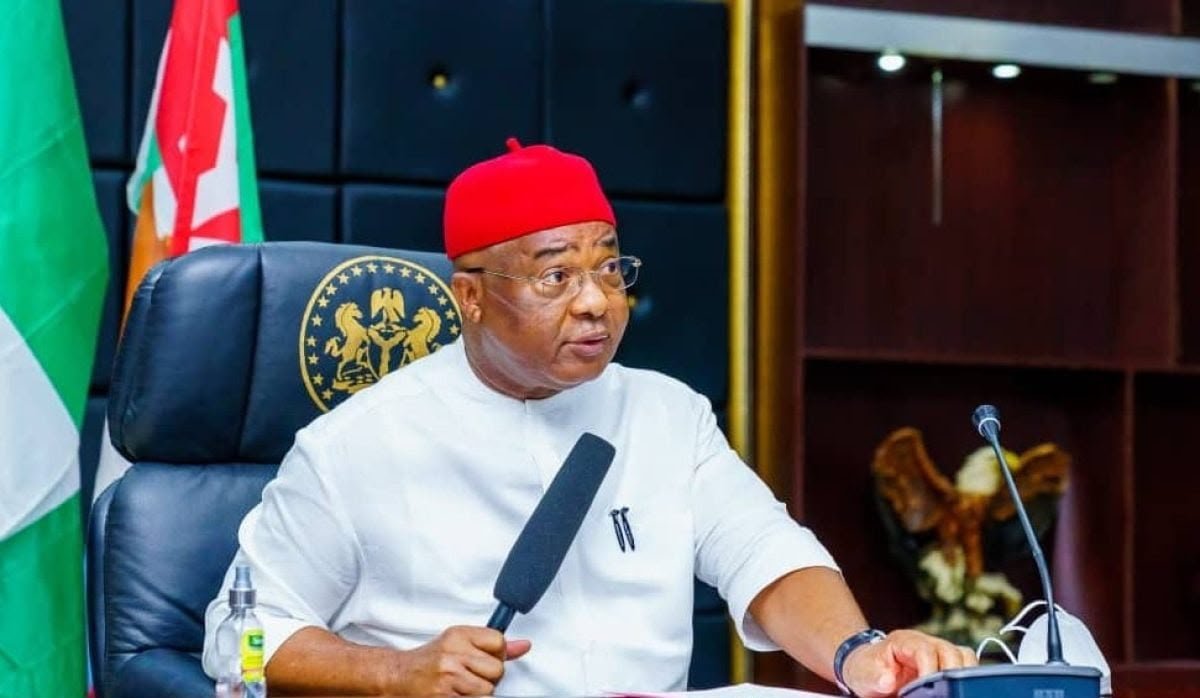
Every government eventually reaches the same doorstep: who comes next?
In Imo State, that question is already beginning to attract attention, even though the 2027 governorship election is still ahead.
Governor Hope Uzodimma’s succession has entered public discussion through conversations about zoning, the state’s Charter of Equity and the political relationship between the person leaving Government House and the person who eventually occupies it.
A recent warning from Prophet Nnamdi Akujor of Overcomers Christian Mission International in Owerri added another layer to the conversation.
The cleric advised Uzodimma to be careful about who succeeds him, saying he had received what he described as a spiritual revelation of possible disagreement, betrayal and political tension after the 2027 transition.
He also mentioned disputes over zoning and the interpretation of the Charter of Equity.
Those are the cleric’s predictions. They should remain where they belong, as his own spiritual claims, not as evidence that Imo is destined for political crisis.
The political question lying below them, however, is real.
How will Imo manage succession?
That question matters because political transitions rarely begin on election day. They begin much earlier, in meetings, consultations, alliances and conversations that ordinary voters may not see.
Imo’s Charter of Equity has become one of the central pieces of this conversation.
The document is being presented by different political actors as a framework for fairness and rotation among the state’s three senatorial zones: Orlu, Owerri and Okigwe.
Governor Uzodimma has publicly backed the principle of the Charter, while the Orlu socio-cultural organisation, Orluzurumee, has said that recognising the Charter does not mean Orlu has surrendered its right to decide whom it will support in 2027.
The group has called for consultation rather than premature endorsement of either Owerri or Okigwe. That distinction is important.
A political agreement on rotation does not automatically answer every other question.
Which candidate should a zone support? Which political party should carry the ticket? What qualities should the next governor possess?
How much influence should the outgoing governor have in choosing a successor? And where does the electorate fit into all these calculations?
Those questions cannot be settled by zoning alone. They will eventually meet at the ballot box.
The danger in succession politics is that politicians can begin treating the next election as a private family meeting while citizens watch from outside the window.
That is where the old Nigerian political conversation about power becomes relevant.
Chief Obafemi Awolowo once observed that “Power enslaves: absolute power enslaves absolutely.” (Obafemia Wolowo Foundation)
The statement was made decades ago, but its relevance to political succession is difficult to miss. Power is attractive.
Political influence creates friendships, alliances and interests. Leaving office does not necessarily mean leaving politics.
A governor finishing his tenure will naturally have political interests. Supporters will have interests too.
Aspirants will have ambitions. Political parties will calculate their chances. Zones will defend their claims. None of that is unusual.
The question is whether those interests can coexist with the larger interest of the state.
Nigeria’s first indigenous Governor-General and first President, Nnamdi Azikiwe, put another part of the democratic responsibility plainly in his 1963 Independence Day speech: “To no person, no matter how wealthy, should we sell our soul.” (Archivi.ng)
That is a useful warning for every political season.
A succession plan may begin in a governor’s political circle, but the government belongs to the people.
And Imo is not short of political history to remind its people how complicated succession can become.
Every governor leaves behind supporters, opponents, unfinished projects, expectations and people who believe they deserve a place in whatever comes next.
The transition therefore has to be bigger than one man’s preferred successor or one zone’s political ambition.
This is where the Charter of Equity becomes both useful and complicated.
If the Charter is intended to promote fairness among the three senatorial zones, then its meaning must be understood clearly.
If political actors interpret it differently depending on where they stand, the document could become another source of argument rather than the instrument of accommodation its supporters describe it as.
Orluzurumee’s recent position illustrates that tension. The group says it recognises the Charter but also insists that Orlu retains the right to decide who it supports.
Meanwhile, groups campaigning for an Owerri-zone successor have argued that the Charter should be respected.
This is politics doing what politics does: everyone is reading the same document from a different chair.
The Igbo have a saying: “Aka nri kwoo aka ekpe, aka ekpe akwoo aka nri.” The right hand washes the left, and the left washes the right.
It is a simple reminder that political communities survive through accommodation.
There is another saying: “Onye aghana nwanne ya.” Let nobody abandon his brother.
For Imo’s political class, the broader message is not difficult to understand. Competition will come. Ambition will come. Arguments over zoning will come.
But none of them should become more important than the peace and development of the people who remain after the politicians have finished negotiating.
That is why the conversation about 2027 should begin with more than “Who is going to succeed Uzodimma?”
It should also ask:
What should the next governor inherit?
A state divided by political bitterness?
A state where zoning determines every conversation?
Or a state where political rotation can take place without turning communities against one another?
The answer will depend on how today’s political actors conduct themselves.
The recent cleric’s warning has drawn attention because Nigerians understand how quickly political disagreements can become personal.
But Imo does not need prophecy to know that a badly managed transition can create tension. Nigeria’s political history has supplied enough examples.
The wiser course is to start the conversation early, keep it open and allow different zones and interests to speak without treating disagreement as betrayal.
There is still time. The 2027 election has not arrived. No candidate has won anything. No zone owns the electorate. And no political agreement can remove the voter’s final constitutional role.
That may be the most important point of all. Imo’s next governor should not simply inherit a seat.
He or she will inherit the hopes, frustrations, debts, roads, schools, hospitals, businesses and unfinished work of millions of people.
So before the posters become louder and the political meetings become more secretive, Imo should ask itself a harder question than who will succeed Uzodimma?
What kind of successor does the state actually need? That question is bigger than 2027.
It is about what Imo wants to become after the campaign drums finally go quiet.







Leave a comment