By: Chioma Madonna Ndukwu
Africa’s Talking Drum: The Man Who Counted His Yams but Forgot His Hungry Neighbours
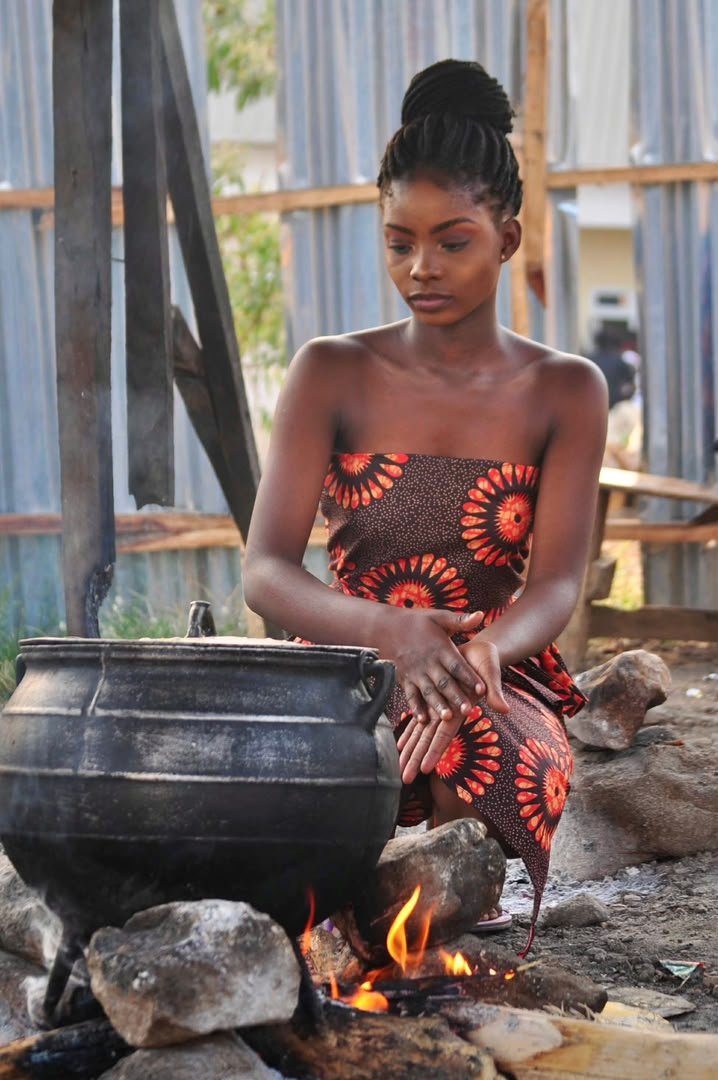
Every morning, the people of Umuagu woke to the smell of cooking, but in Mama Nnenna’s compound, an empty pot sat above a cold fire.
Her husband had died during the previous planting season, and the drought had swallowed what remained of her harvest.
With three hungry children depending on her, she had begun exchanging her firewood for handfuls of cassava flour.
One evening, her youngest son, Obinna, tugged at her wrapper.
“Mama, will we eat tonight?”
She stroked his dusty cheek. “My child, even the longest night eventually gives way to morning.”
“But my stomach does not understand morning.”
Mama Nnenna turned away to hide her tears.
The next day, she carried her empty pot to the village square, hoping someone might offer her a little grain.
There she met Ogbuefi, the wealthiest farmer in Umuagu, whose barns were filled with yams, maize and beans.
“Please, sir,” she said, “lend me a small bowl of maize. I will repay you after the next harvest.”
Ogbuefi laughed.
“If I feed every hungry person, what will remain for my children? A farmer must protect what belongs to him.”
Mama Nnenna returned home with her empty pot. That night, however, a strange sound came from Ogbuefi’s barn. He rushed outside and found his storehouse shaking.
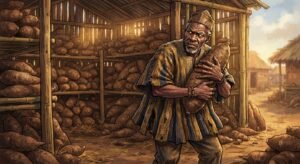
His baskets toppled, his yams rolled across the floor, and every grain of maize seemed to disappear into the darkness.
“Thief!” he shouted, chasing shadows through the compound.
At dawn, he summoned the village elders.
“I have been robbed! Someone has stolen my food!”
The oldest elder, Nze Okafor, examined the scattered baskets.
“Tell us, Ogbuefi, when did you last share your harvest with someone who was hungry?”
The farmer folded his arms.
“What has that got to do with theft?”
Nze Okafor replied, “A granary can be full while a village starves. Tell me, what good is a harvest if hunger has made your neighbours strangers?”
Ogbuefi became angry, but he could not answer. That afternoon, he visited Mama Nnenna’s compound.
He found her gathering dry leaves while her children sat beside the cold cooking fire. Without speaking, he placed a basket of maize, yams and beans before her.
She stared at him in disbelief.
“Why have you brought these?”
“Because I have enough to eat, yet I allowed your children to go hungry.”
Mama Nnenna lowered her eyes.
“May your kindness return to your household.”
Ogbuefi shook his head. “Do not thank me yet. Tomorrow, I will ask the village to help us build a communal granary, where every farmer can contribute after harvest and families in need can collect food.”
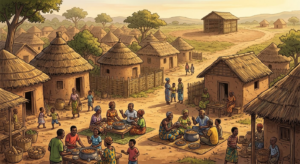
The following morning, the villagers gathered to plan the granary. Some offered maize, others contributed yams, and the younger men volunteered to build the storehouse.
As the first basket entered the granary, Obinna tugged at his mother’s wrapper.
“Mama, will the pot boil tonight?”
She smiled.
“Yes, my child. And tomorrow, we shall remember that no family should have to beg for the food that keeps it alive.”
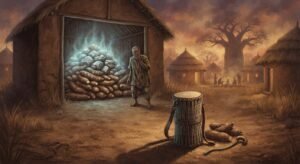
From that year onward, Umuagu celebrated every harvest by setting aside food for households in need.
Moral:
Food is more than a farmer’s reward; it is a shared necessity. A community grows stronger when its harvest feeds both the fortunate and the hungry.