

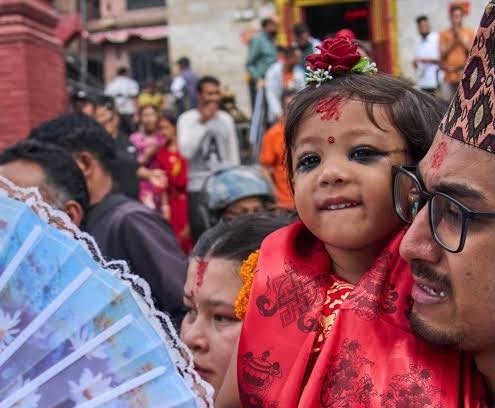
Two-year-old Aryatara Shakya has made her first major public appearance as Nepal’s newly appointed Kumari, taking part in the colourful Indra Jatra festival in Kathmandu.
The young girl was carried through the historic heart of the Nepalese capital as thousands of devotees and visitors gathered around Kathmandu Durbar Square to see her during the annual celebration.
Despite heavy rain, crowds lined the traditional route as Shakya was taken through the city on a ceremonial chariot. Her appearance marked her first Indra Jatra since she was chosen to serve as the Kumari, a role in which a young girl is revered as the living embodiment of the goddess Taleju.
She appeared alongside two other living deities, Ganesh and Bhairab, who were also carried through Kathmandu on separate chariots.
For worshippers, Shakya’s participation added special meaning to this year’s festival. One attendee, Loyal Chale, said he had waited for about three hours for the opportunity to see the new Kumari.
The Kumari tradition is closely associated with Nepal’s Newar community and reflects the centuries-old relationship between Hinduism and Buddhism in the Kathmandu Valley.
Becoming a Kumari involves a demanding traditional selection process. Candidates must meet a series of physical and cultural requirements, including being in good health, having no significant scars or bodily marks, possessing a complete set of teeth and not having begun menstruation.
Those who meet the initial conditions are examined against 32 traditional physical characteristics regarded as signs of perfection.
Traditional descriptions include a body compared with a banyan tree, eyelashes resembling those of a cow, a neck likened to a conch shell and a chest associated with the strength of a lion.
Candidates are also expected to have qualities such as straight black hair, dark eyes, soft hands and feet and a clear voice. Traditional beliefs also place importance on qualities including calmness and courage, as well as an astrological chart considered compatible with that of the king.
The selection process has a particularly demanding ritual. Candidates are traditionally placed in a frightening setting involving sacrificed buffaloes and masked dancers as part of a test of courage. A visible reaction of fear can lead to disqualification.
Once selected, the Kumari leaves her family home and moves into Kumari Ghar, a historic palace in Kathmandu.
Her daily life is governed by strict customs, with contact with family members limited and public appearances restricted to specific religious and ceremonial occasions. Indra Jatra is among the most important events during which she is presented to the public.
The festival itself is rooted in an ancient legend involving Jayanta, the son of Indra, the Hindu deity traditionally associated with rain.
According to the story, Indra came to earth in search of white flowers for his mother but was captured and tied up by residents of the Kathmandu Valley. The story has remained part of the cultural foundation of Indra Jatra, which is celebrated over several days.
The festival is particularly important to Newar communities practising Hinduism and Buddhism, with related celebrations also taking place in Nepal’s Kavre and Dolakha districts.
Senior government officials attended this year’s procession, including President Ram Chandra Paudel, Vice President Ram Sahaya Prasad Yadav, acting Prime Minister and Finance Minister Swarnim Wagle, Home Minister Sudhan Gurung and acting Kathmandu Mayor Sunita Dangol.
For Aryatara Shakya, the procession was more than a festival appearance. It marked the beginning of her public role as Nepal’s newest Kumari and placed her at the centre of one of the country’s most enduring religious and cultural traditions.











Leave a comment