

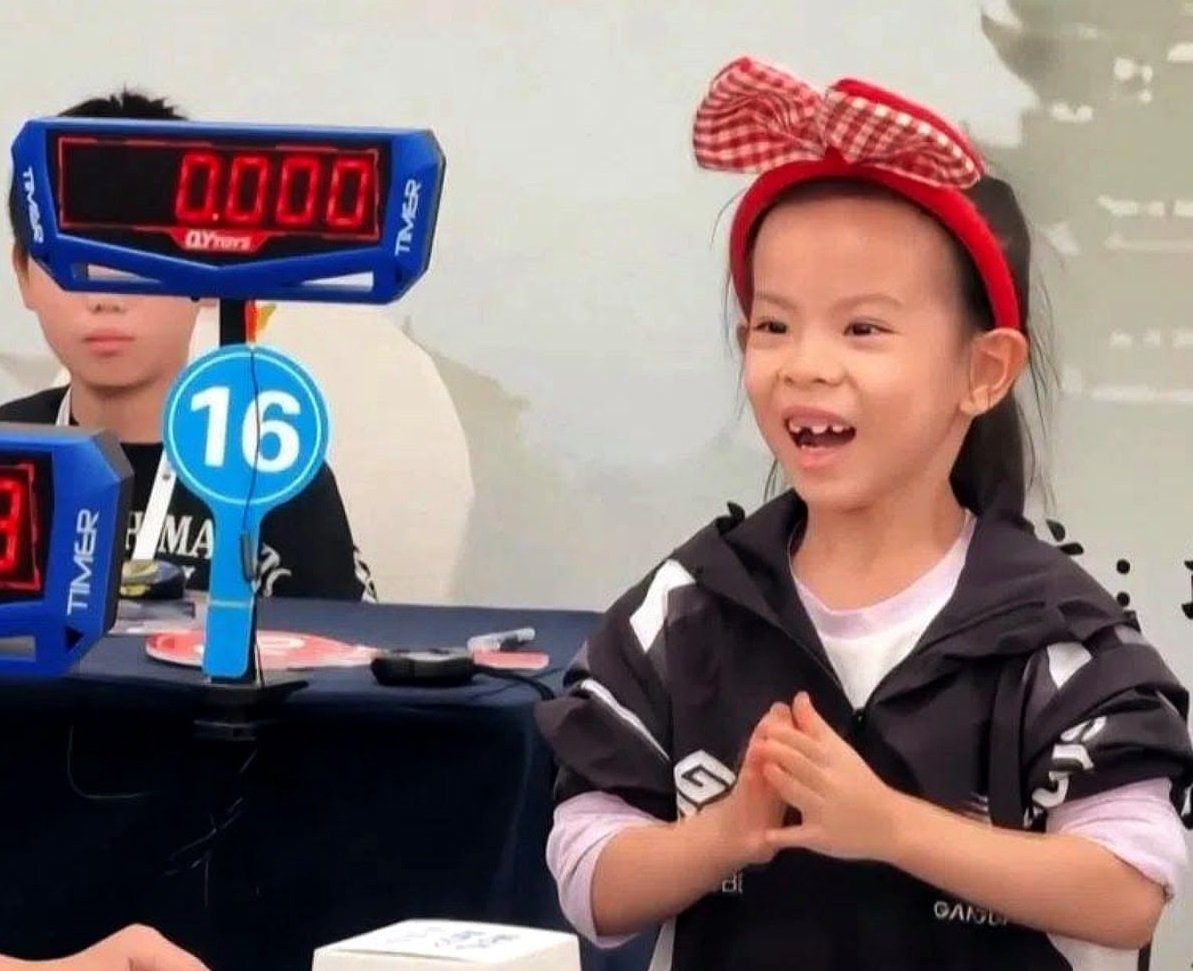
A six-year-old Chinese girl has stunned the speedcubing world after setting a new women’s record for solving a 3×3 Rubik’s Cube.
Lian Yunzhi, popularly known as Zhizhi, recorded an average time of 4.27 seconds at a World Cube Association competition in Guangzhou on September 16.
The achievement saw her break the previous record of 4.52 seconds, which she had set earlier in the month. In individual attempts, the young cuber has also completed the puzzle in less than four seconds.
Her mother, Lin Yangxi, said Zhizhi was thrilled when she learned that her hard work had produced another world record.
“She was overjoyed and felt that all her hard work had paid off,” Lin said.
The achievement has also turned the kindergarten pupil into a minor celebrity at school. Her mother said older students now visit Zhizhi’s classroom carrying pieces of paper and asking for her autograph.
“The whole school knows her now,” Lin said.
Zhizhi’s journey began when she was four years old. At the time, speedcubing was only one of several activities her parents had chosen for her. She also attended dancing, painting and gymnastics classes.
Her parents eventually noticed that she had a particular interest and potential in solving the puzzle and decided to devote more time to the activity.
Lin said the Rubik’s Cube had also helped her daughter develop skills such as concentration, memory, logical thinking and spatial awareness.
The road to the world record, however, was not always smooth.
After months of training, Zhizhi managed to reduce her average solving time to about eight seconds. She then struggled to improve for several months despite continuing to practise.
“For about three or four months, no matter how she practised, her times didn’t improve at all,” Lin said.
The lack of progress became frustrating enough for the family to consider giving up.
A change came after Zhizhi began working with a specialist coach in Shanghai. She subsequently learned more than 1,300 Rubik’s Cube formulas, and her solving speed began to improve rapidly.
Today, the young record-holder trains for between two and three hours on weekdays. Her weekend schedule can stretch to six hours, although competitions also give her an opportunity to meet other young cubers and take a break from regular practice.
According to her mother, Zhizhi once envied children who appeared to have more time to play. She eventually came to see her own training differently.
Lin said her daughter later explained that pursuing her own goals made her happy, even if it meant spending less time on other activities.
Her parents are also monitoring the demands of intensive practice. Although serious injuries are uncommon in speedcubing, Lin keeps an eye on her daughter’s eyesight because of concerns about myopia, or short-sightedness.
The pressure was especially high during the competition where Zhizhi broke the record. Her parents were extremely nervous as they watched her compete, but Lin said she was impressed by the way her daughter handled the moment.
Despite her success, Zhizhi’s mother does not expect her daughter to make speedcubing her lifelong career.
For the family, the value of the sport goes beyond the records. They believe the discipline required to master the puzzle can teach Zhizhi perseverance and patience that may benefit her in whatever career she eventually chooses.
“We just wanted to accompany her as far as she could go,” Lin said. “It can forge some grit and perseverance in her, which will serve her well in whatever she chooses to pursue in the future.”













Leave a comment